Monday, November 10, 2008

Paraphrase Passport for Reading

The protocol for the paraphrase passport strategy is as follows:

  1. Students pair up A and B, and they sit shoulder to shoulder, not facing each other.
  2. A reads to B for 30 seconds with both students looking at the text.
  3. Then B puts the text face down and paraphrases to A what was read.
  4. For the next 30 seconds B reads to A (starting where the partnership left off), followed by A's paraphrase.
  5. Rotations continue until the students finish reading the text.

Many teachers at last week's site visit were skeptical of the strategy because of the noise that might happen in the room and because the teachers felt comprehension would go down because students do not read at the same pace. However, Beth Neary tried the paraphrase passport reading strategy in her small, AP Spanish Literature class, and she sent this report.

Positives – 9 students want to do it many more times this year!
· If you missed part of the reading, your partner recaps/explains it to you
· It is a fun way to read
· It keeps you focused while reading as you have to keep switching roles
· “I know a lot more because we read it two times” – translated by Beth Neary

Negatives – 1 student did not like it that much, but was fine if we do it again
· It takes longer to read
· It loses a bit of the excitement as you have to keep stopping


Suggestions from students:
· Give 2 minutes to read and one minute to recap (I think that’d change due to the difficulty of the reading), but the short 1-2 minute periods were actually more effective than Beth thought they’d be.

Observations by Beth:
· The students were really into it and wanted to continue the whole hour to finish the story.
· While they recapped, Beth heard them actively analyzing. Examples heard: “I bet the apron represents the lower class.” “I bet the seƱora will do something crazy.” “He’s definitely criticizing class struggles – Neary’s going to make us write an essay on that.”

Basically, the observation Beth had was that the strategy helped students cue into what was important in the reading. Beth was quite surprised. She liked it!

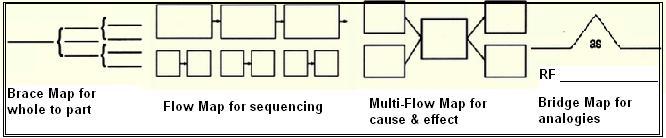
Multi-flow Map for Character Change

Kristin Benson's student teacher Sean did a great culminating activity for The Crucible using the multi-flow map to uncover the central conflict for each of the main characters in the play. He assigned groups to focus on one main character like Abigail, John Proctor, Rev. Hale, Rev. Parris. Then kids were asked to find a quote from the beginning of the text as a cause, a quote from the end of the play as an effect and to write a paragraph of explanation summarizing their understanding of each quote. Then as the last step, kids filled in the central conflict for their character. He phrased it like this on his model map, “What causes your character to go from this person at the beginning to this person at the end?” The end products really yielded some higher level thinking.

Tuesday, October 7, 2008

A to Z Taxonomy

A number of English teachers have recently had great success with using an A to Z taxonomy to help students uncover the themes and symbols in a novel.

With Animal Dreams by Barbara Kingsolver in English 10 the students went through the steps of creating a personal taxonomy, sharing ideas in a small group, reporting to the full class, and then composing with key words to get a start on their literary analysis essay.

To report a word for the taxonomy to the class, students used an oral speaking frame that stated: "I have a/an ____ to contribute to the "Search for Self Taxonomy" and it is _________ because Kingsolver believes ______________ about finding yourself, and this word represents _____________________."

The depth of the student reports when adding to the taxonomy were deeper than I have ever seen with the taxonomy, and many of the words that students shared were symbolic. In fact, the taxonomy finally allowed students to see symbols that they had been struggling understanding prior to the taxonomy.

The amazement with the taxonomy's success was reiterated by English 10 teacher Rachel Tholen, who reported: "The kids are creating their taxonomies. It’s amazing. It’s the best thing we’ve done with this book so far. I’m a total convert to the taxonomy."

Rachel emailed again after another successful class period, stating: "I know I’m a broken record on the taxonomy, but my sophs are finishing up our discussion on the search for self taxonomy today, and I can’t believe how well it works. It may be the perfect way to teach symbol. My second hour had some thoughtful things to say about the afghan, and how it represents comfort and safety for Codi, but also how it's woven together by Uda, and how the older women in the community weave together the relationships, past, and history of the town and the people in it."

Kristin Benson also reported that the taxonomy worked well to discuss the rebel theme in Catcher in the Rye.

Youth and Digital Literacy

A number of Edina teachers attended Jabari Mahiri's session on digital literacy on Sept. 30. We were able to discuss ways to improve youth literacy through digital mediation. Mike Walker, Edina's Technology Integrationist, blogged right from the workshop. So click here to read all about Jabari's workshop.

Thursday, September 18, 2008

Science and Thinking Maps

Two science teachers recently shared with me some exciting uses of Thinking Maps in their classes.

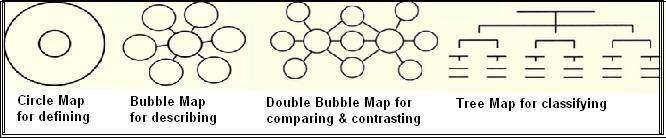
Mike Roddy used a circle map to activate students' prior knowledge on cycles in his physical universe class. In the circle students defined cycles with synonyms, symbols, ideas and examples of cycles. In the frame they elaborated on why they included ideas. Then Mike used a second color marker and put astronomical in front of cycles, and students added words that defined the new concept astronomical cycles. The students were able to make lots of connections between astronomy and their prior knowledge of the term cycle. After they finished the circle map, Mike pointed out that circle appeared on the definition of cycle, and "isn't it cool that we did a circle map?" The joke bombed. I apologize to Mike because I had made that comment to him earlier when I realized the connection between cycle and circle.

Mark Harelstad has adopted the flow map in his biology class. Not only does he have the unit flow map posted in front of the room to keep his lessons flowing, but also he used a flow map to teach his students about the scientific method. Mark gave them the individual steps of the scientific process, and they had to construct a flow map that indicated the correct order of steps. Now, those steps are posted in the lab on posters, making a big flow map of the scientific method, and students need to follow the same steps for every biology lab.

Thanks science for sharing your stories.

Thinking Maps for Study Skills

High School 101 is a class designed for sophomores to explicitly teach them the skills necessary to be successful in high school and to improve their English and math skills. One teacher manages the class, contacting teachers and parents for information updates on the students. Other high school teachers work with the students one or two days a week on specialized topics. Two days a week the students work on language arts skills. Two days a week on math skills. And one day a week they work on general study skills.

I designed a unit to be implemented in a series of study skills days, and Doug Eischens, the school social worker, is team-teaching the unit with me.

During the Thinking Maps Unit students move from guiding questions on their lives in general to guiding questions that specifically deal with their academic habits and life as a student. Examining themselves as students will allow them to evaluate their study skills and school habits. The bridge map serves as the bridge between their lives in general and their lives in school.

Each map is presented in this sequence:

  1. Students learn the map by making one with personal information.
  2. Doug debriefs the personal information to blend the students' social/emotional needs with their academic needs.
  3. Students are taught practical ways to use the map for reading and lecture comprehension with content from their current English 10 course, social studies course, and/or science class.

Here's the lesson from the first day--

Tree Map

Jackie Teaches the Tree Map:

What was your youth culture like when you were in elementary school? (branches of tree map are recreation, clothing, and family traditions) Frame: Simultaneously jot down stories that go with the items. This map will be used first as a community builder since students will mingle and share their information. All students must share this information but will be told that ahead of time.

Doug Debriefs the Personal Information:

Introduction to the idea that sharing will happen after each map is completed, but students will only be asked to share what they are comfortable sharing. Doug plans to facilitate the after each map debriefs similar to how he runs his student support groups. The students really enjoyed this activity as a way to find out things that they had in common with other students in the room. Doug told them that a support network of friends at school is key, so this sharing of cultural backgrounds really helped that.


Jackie Makes Content Connections and Study Skill Applications:

I wanted to show the students some practical study skill uses for the tree map. I had the students make tree maps for the main character in their English 10 novel in their English notebooks. I have students in two different English classes, so I just did both novels on the white board at once. The English 10 students mapped Codi’s (Animal Dreams) clothes, recreation, and family traditions, and the boys in Guys 10 did the same three branches for Siddhartha. This activity helped students bring the characters to life and allowed them to make personal connections.

Then, I made the students pull out their history notebooks and look at their last lecture notes. I had the students create category titles for a tree map on Mesopotamia--and they came up with religion, literature, and government. They reviewed their notes and synthesized their notes in a tree map. Making a tree map for lecture reflection was hard for them to do, but the product was fascinating.

Stay tuned for future installments of how teaching the other maps goes in High School 101. The circle map is on tap for next week.